📄 Digital book in PDF · read it on your phone or print it
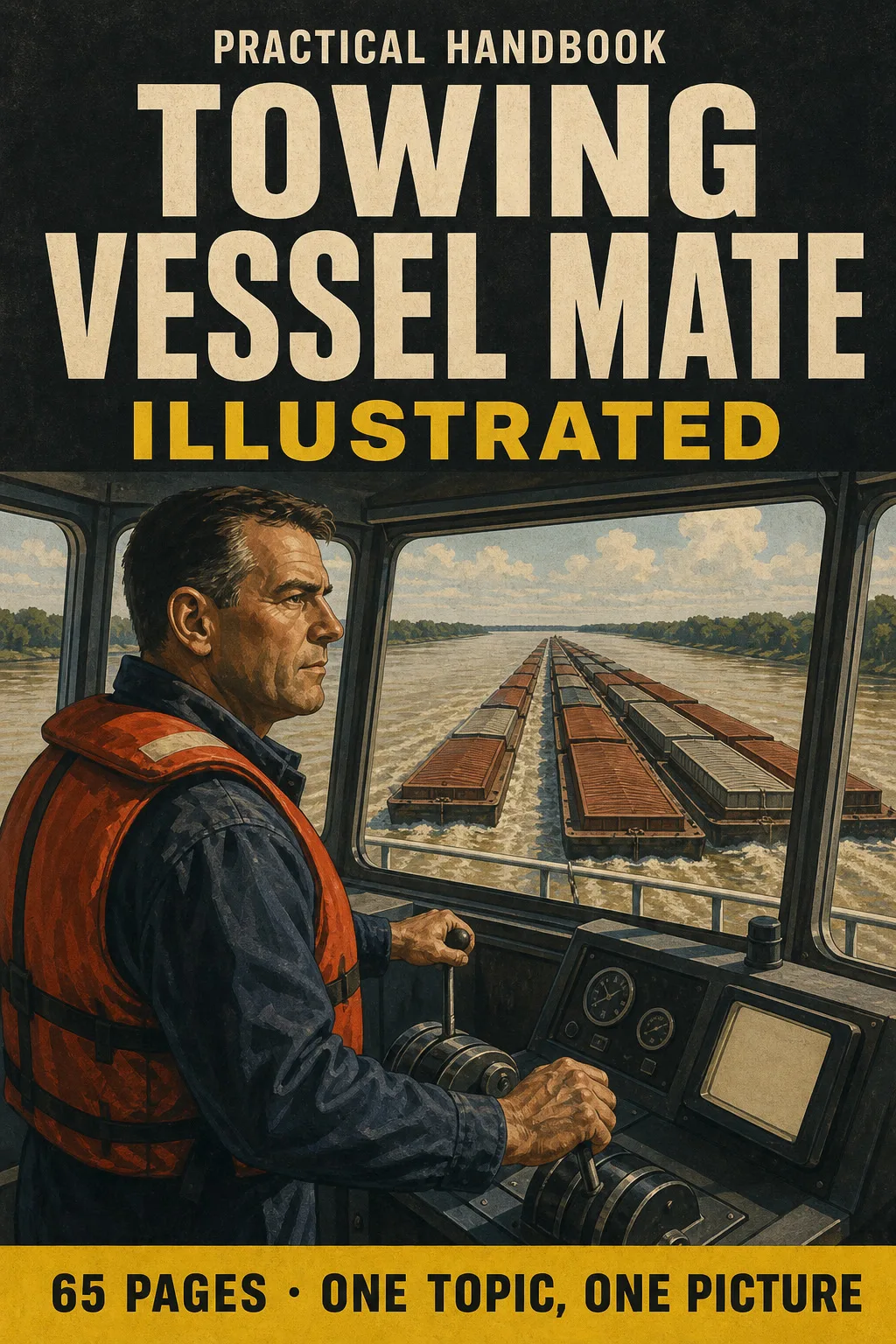
Towing lights and day shapes, light arcs, meeting and crossing, sound signals, face wires and barge layouts, river miles and locking through. Every topic gets its own page: the drawing first, then what you need to remember. 65 illustrated pages.
🔒 Secure checkout · PDF by email · 30-day guarantee
Every page has one big drawing and a box with the rule numbers, arcs and distances you need to know:


Swipe to see more →
These are real pages from the book. The table of contents is the full one: 9 parts and 61 topics.
You're on night watch and a towboat comes around the bend with two white lights stacked on her mast. Is she towing astern or pushing ahead? The answer is at her stern, and you're not sure what to look for.
The Rules book gives it to you in one long sentence: two masthead lights in a vertical line, sidelights, a sternlight, a towing light in a vertical line above the sternlight. It's all words, and at night words don't help.

In this book, towing astern is one page. The boat is drawn from ahead, abeam and astern with every light lit: two white masthead lights, red and green sidelights, the white sternlight and the yellow towing light right above it. Rule 24(a) sits in the corner so you can check it.
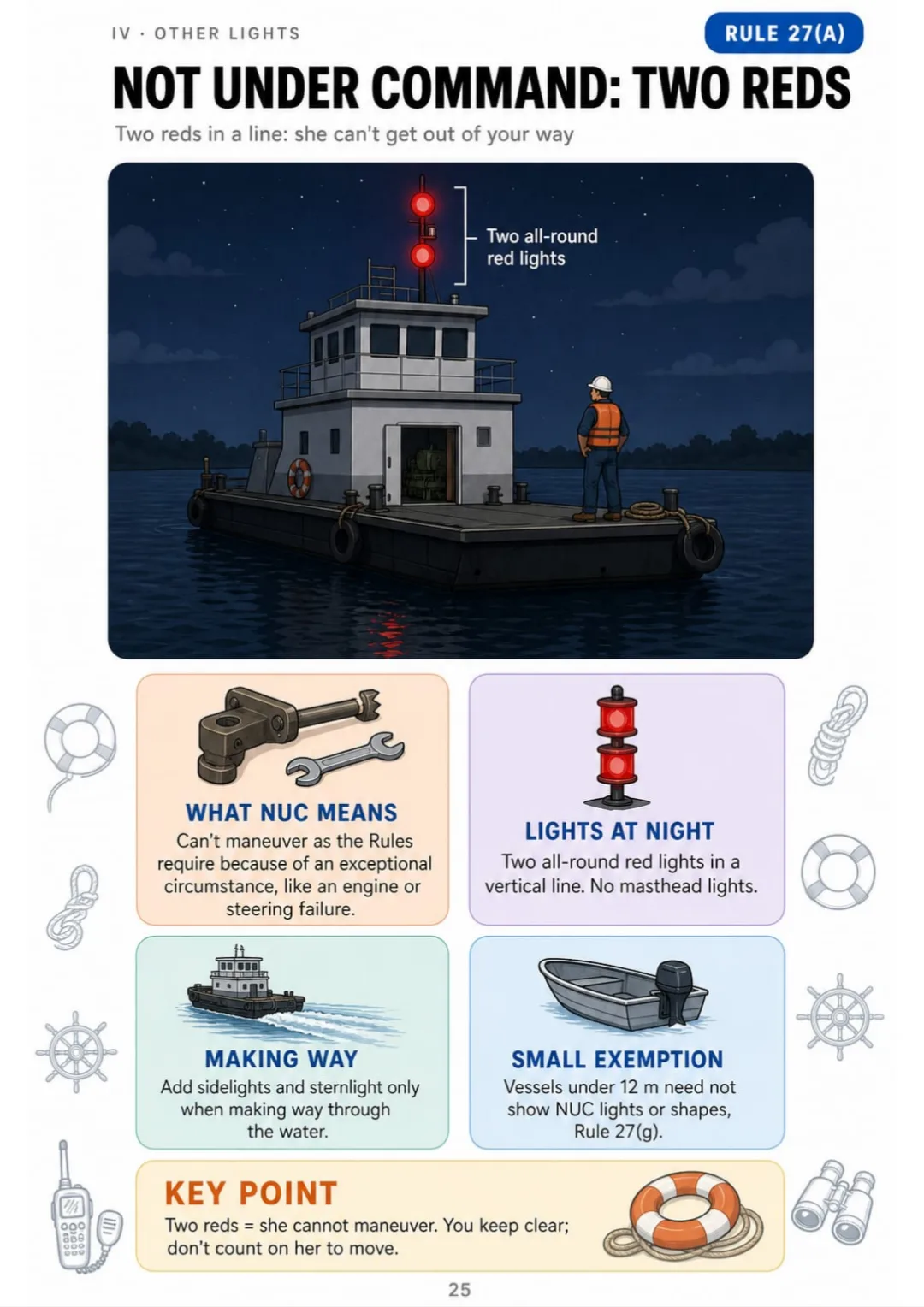
Every other topic works the same way: pushing ahead on the Western rivers, not under command, the light arcs, short and prolonged blasts, locking through. Each one on its own page.
Next time you see one yellow over a white sternlight, you know there's a hawser and a tow behind her. Two yellows and no white? She's pushing ahead. You call it without going back to the book.

Your license and the exam, light basics, towing lights and shapes, other lights you'll meet, steering and sailing rules, sound signals and radio, making up the tow, river charts, aids and locks, and a final review: 65 pages, all illustrated.
Think of it this way:
You're steering upbound at night and a set of lights shows up above the bend. You've got a few seconds to read them and decide how you'll meet her.
In the book you open the towing lights pages and every combination is drawn the way you'd see it from the wheelhouse: towing astern, pushing ahead, towing alongside, Inland right next to the Western rivers.

Same with the whistle signals, meeting and crossing, face wires and fore-and-aft wires, the river mile systems and locking through: each one has its own page.
Towing Vessel Mate Illustrated is 65 illustrated pages in 9 parts, every topic drawn, and it ends with the common mix-ups, the numbers to know cold and a watch checklist.
What you see drawn, you don't have to memorize.
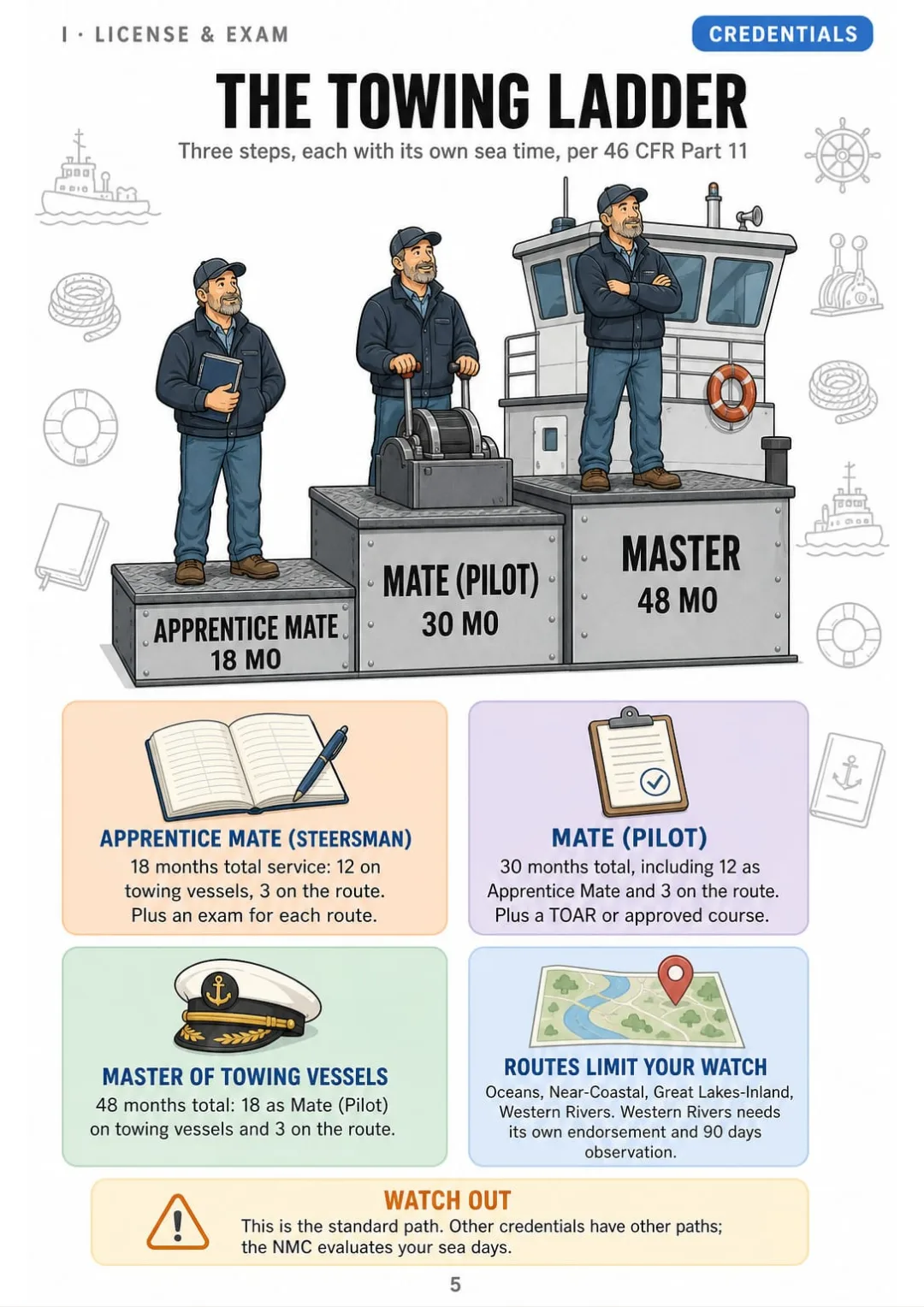
Know exactly which license you're going for and what the exam asks: the ladder from apprentice mate to master, what the TOAR covers and who signs it off, the exam modules, and where Inland, International and Western rivers rules apply.
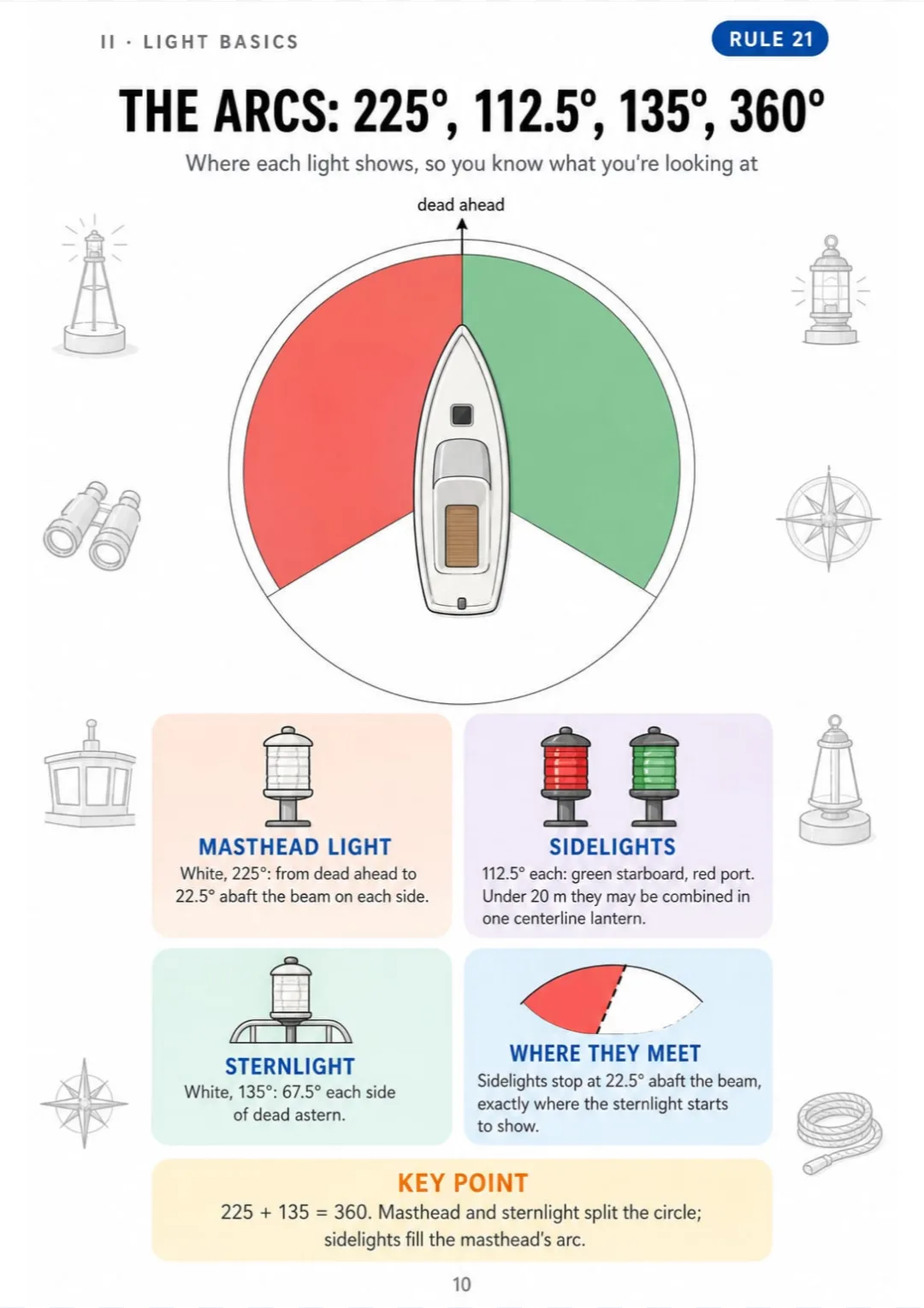
The light arcs, the yellow towing and special flashing lights, visibility ranges, reading a vessel's aspect from her lights, and the four day shapes.
Towing astern, tows longer than 200 m, pushing ahead or alongside under Inland and Western rivers rules, lighting the barges, composite units and hard-to-see tows.
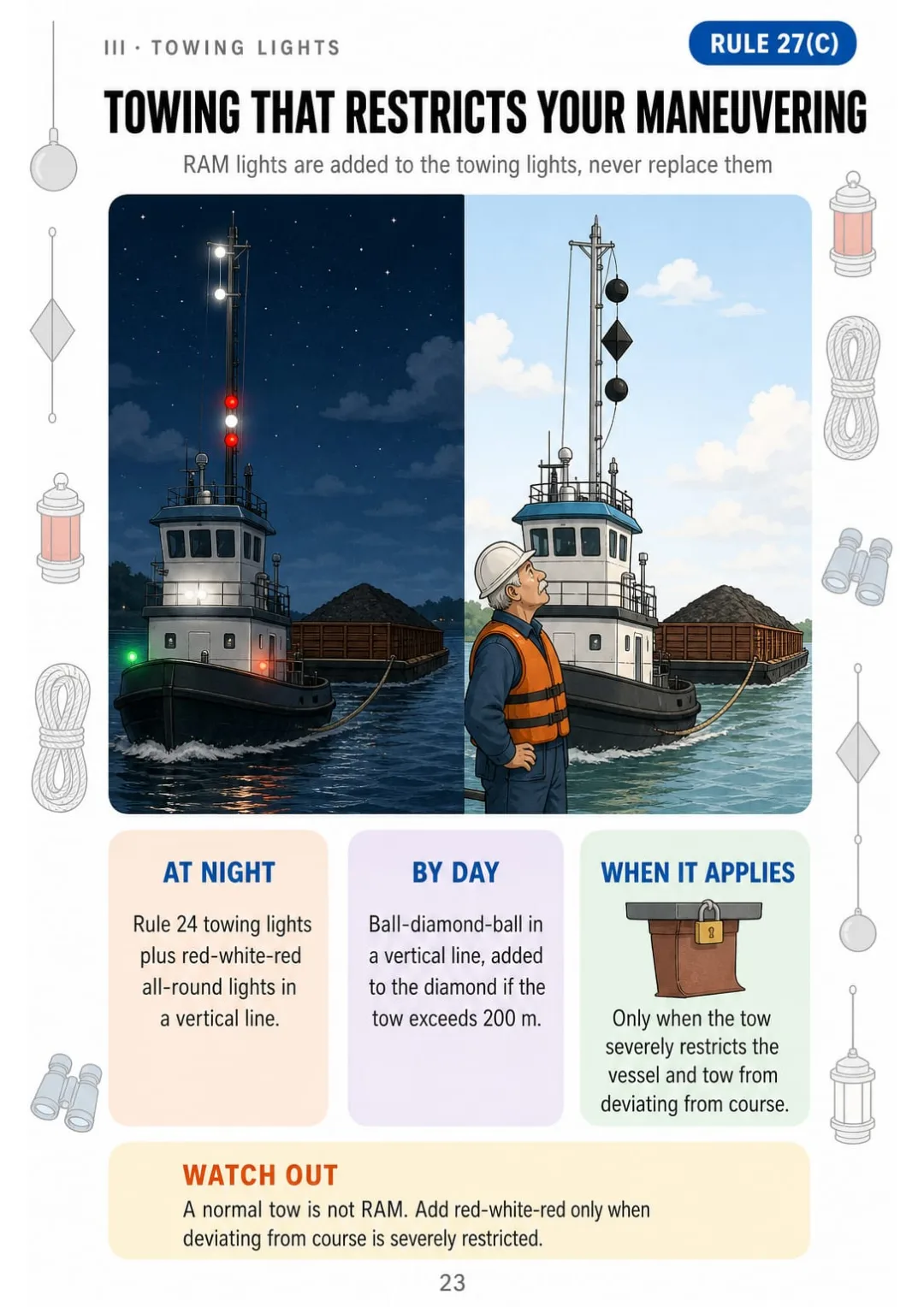
Not under command, restricted in ability to maneuver, dredges and underwater work, anchored and aground, barges moored at the bank, fishing and small craft.
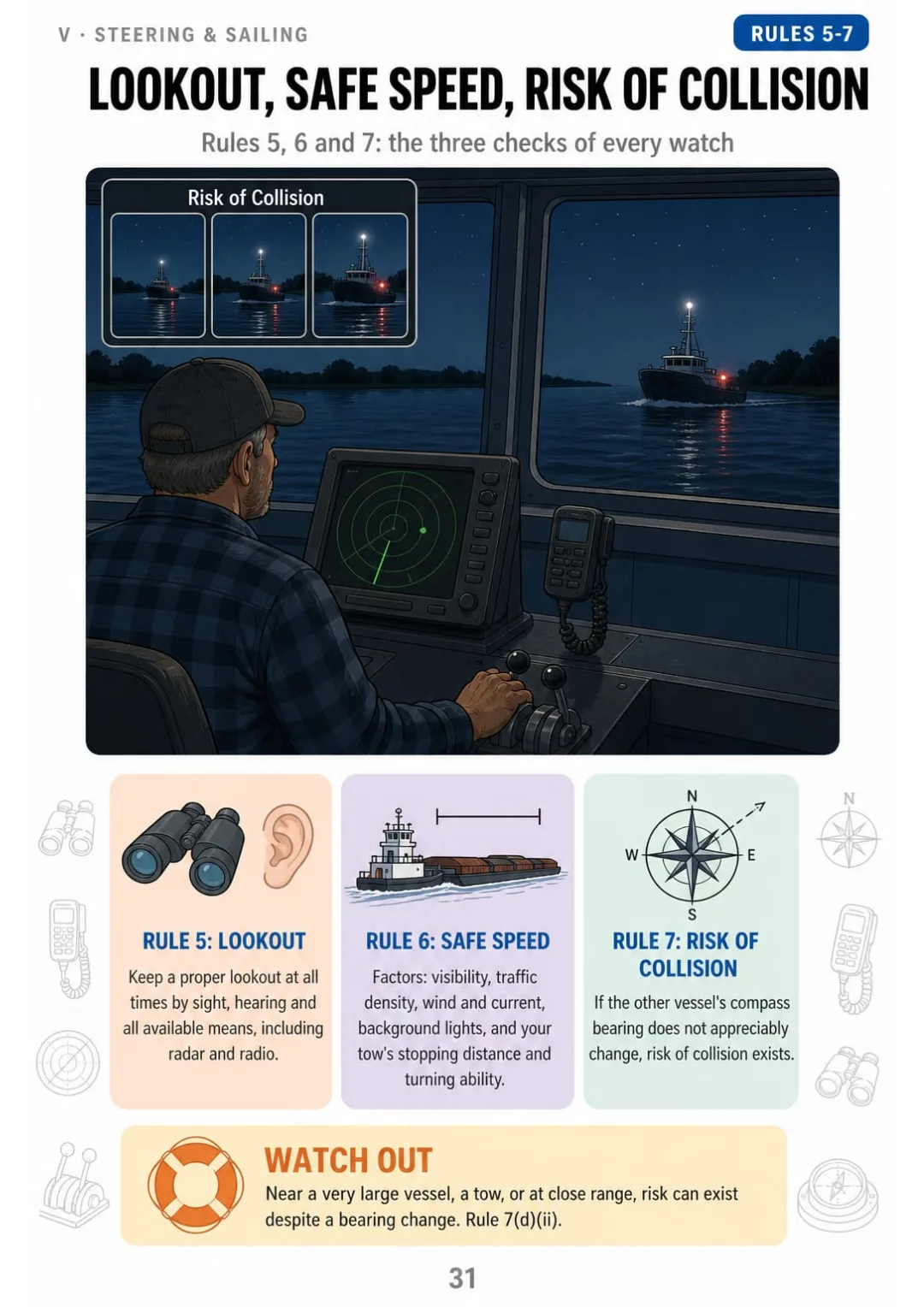
Lookout, safe speed and risk of collision, narrow channels, downbound right of way, head-on, crossing, overtaking and the pecking order.
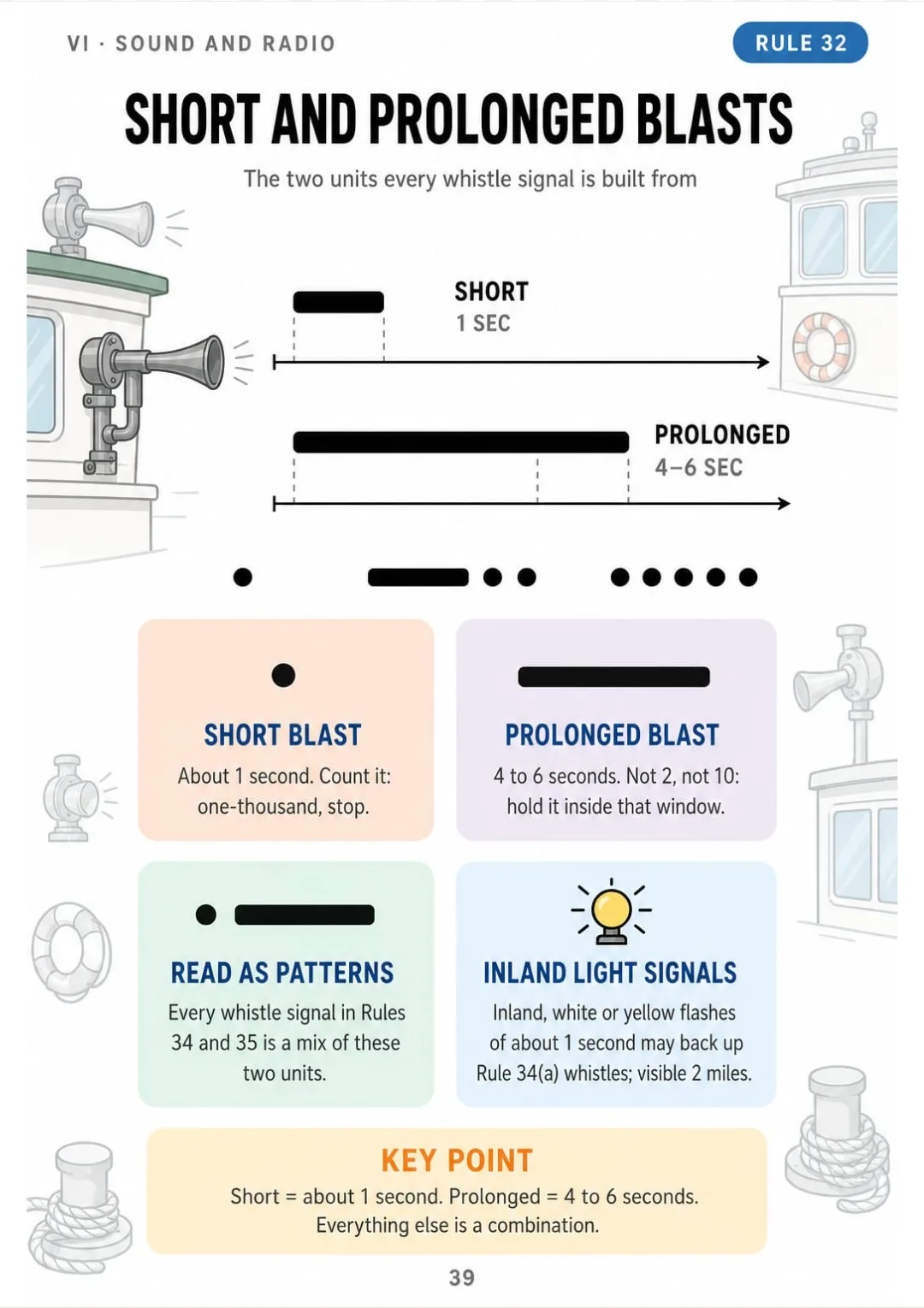
Short and prolonged blasts, Inland intent vs. International action, overtaking signals, danger and bend signals, fog signals, radar and Channel 13.
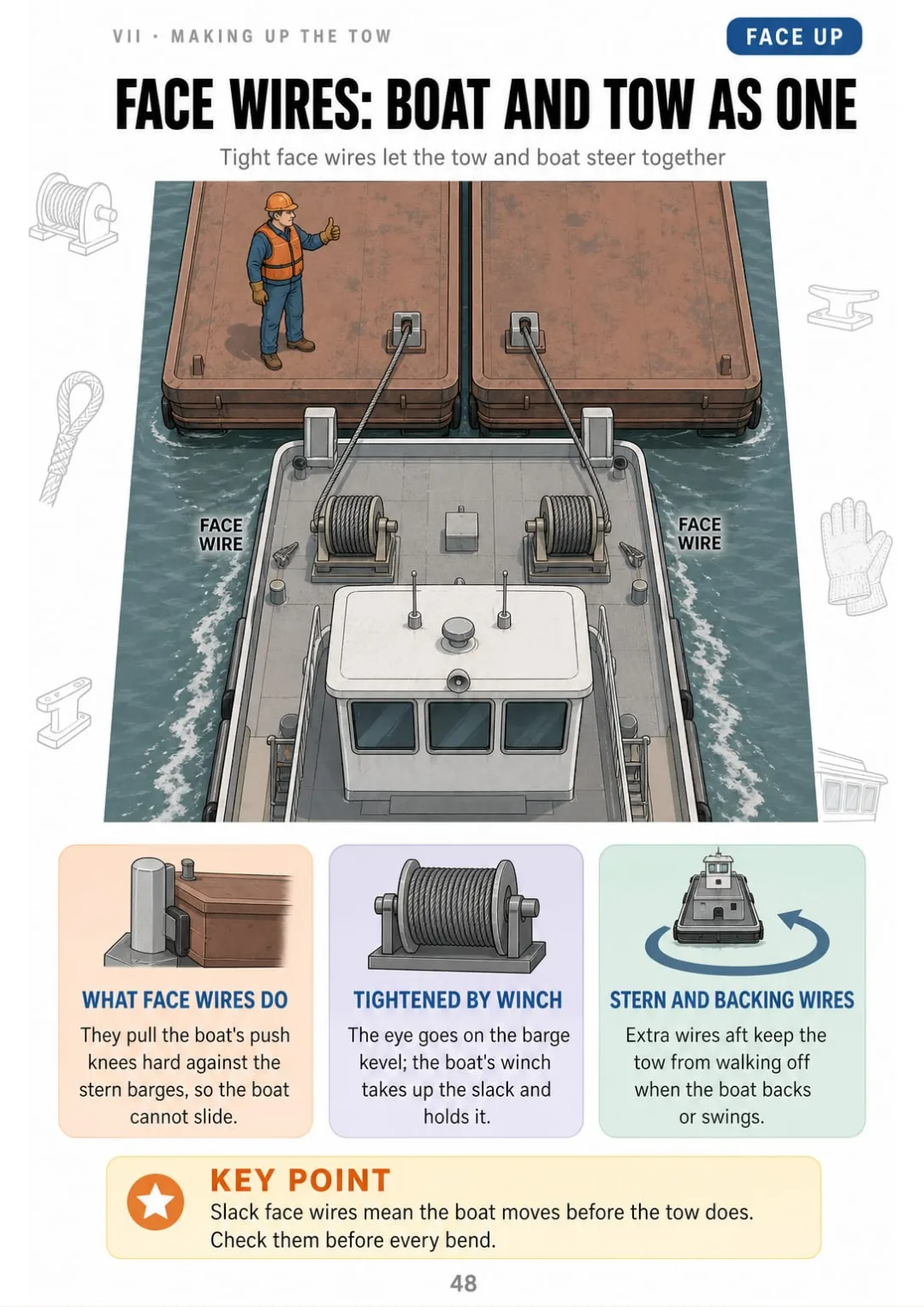
Make up a tow and know why each wire goes where: barge sizes and layouts, kevels, timberheads and ratchets, face, fore-and-aft, breast and jockeying wires, snap-back zones, and breaking up a tow for a short lock.
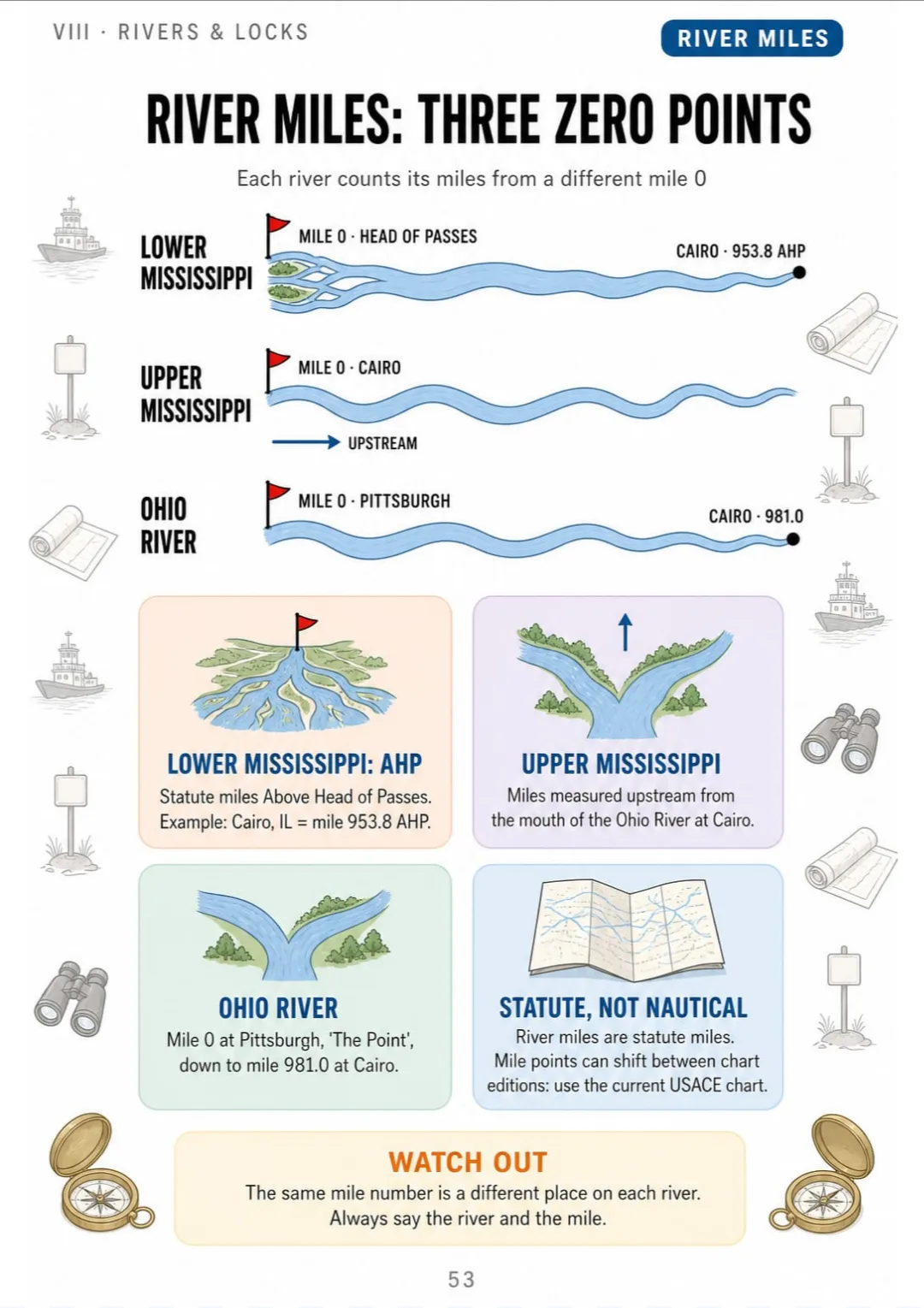
River mile systems, right and left descending bank, Western rivers daymarks, buoys, reading a chart page, approaching a lock, locking through and bridges with current.
The 8 Inland vs. International differences on one page, towing astern vs. pushing ahead at night, the numbers to know cold, a last exam review and a watch checklist.
At the end of the book: A final review with the 8 Inland vs. International differences, the numbers to know cold and a wheelhouse watch checklist.
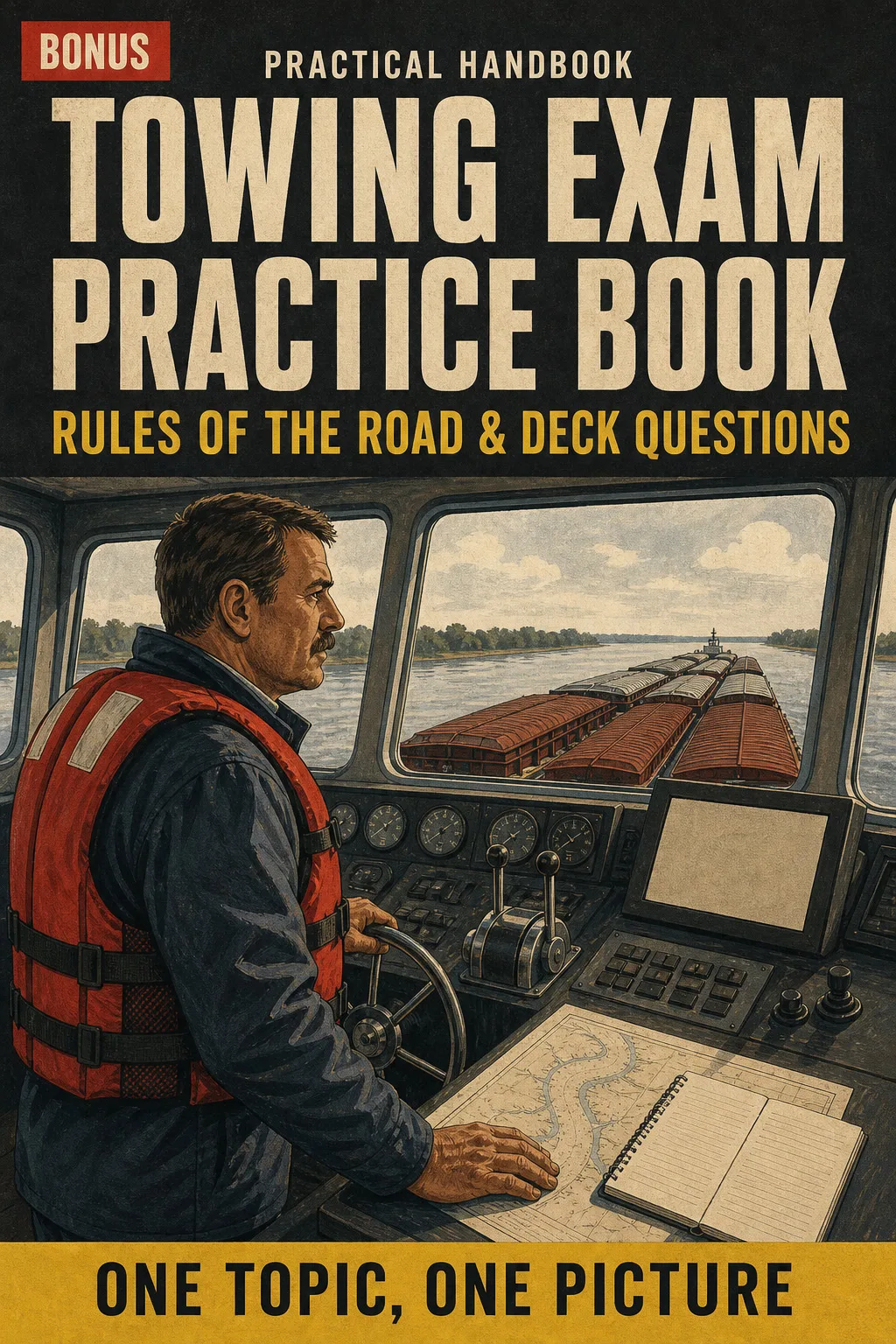
Exam-style questions on lights, sound signals, meeting and crossing, rigging and safety, each answer pointing you back to the page with the drawing, so you know exactly what to review.
The mix-ups made most often, side by side on one card each (towing astern vs. pushing ahead, inland vs. international, one short blast vs. two), ready to print and keep in the wheelhouse.
📄 This is a digital PDF book sent to your email: nothing is printed or shipped.
PDF by email: We email you Towing Vessel Mate Illustrated as a PDF, together with the two free books. It's a single payment: no installments, no extra charges.
You study between watches with one topic per page, so ten minutes in the galley is enough to review a full set of lights or a rigging step.
The final review puts the mix-ups and the numbers side by side, and the practice book points each answer back to the page with the drawing.
You print the pages you need and keep them at the console: lights, whistle signals and lock approaches, ready to check on watch.
📄 This is a digital PDF book sent to your email: nothing is printed or shipped.
Try Towing Vessel Mate Illustrated for 30 days, bonus books included.
We refund everything if the file won't open, if the book isn't what you see here, if you were charged twice or if the email doesn't arrive. Just email us.
You pay once. No subscriptions.
Yes. It's written for working deckhands going for apprentice mate (steersman), mate or master of towing vessels, not for recreational boating: towing lights, Western rivers rules, making up a tow and locking through. Short sentences, one drawing per topic, and Inland, International and Western rivers compared on the same page.
From the USCG Navigation Rules and Regulations Handbook (Inland Rules, 33 CFR Part 83, and the International Rules/COLREGS), checked against the rules in force, plus 33 CFR Part 26 (bridge-to-bridge radio), 33 CFR Part 207 (locks), 46 CFR Part 11 (credentials) and the USCG Light List. Every page shows its rule number so you can check it against your own copy of the Rules.
No. It's independent study material, not affiliated with the U.S. Coast Guard or the National Maritime Center.
No. It helps you review and understand what you're learning. It doesn't give you a certificate and doesn't count as training or sea time. Approved courses, your TOAR, sea time and the official Navigation Rules are still required.
The app tells you when you got it wrong. The Rules book gives you the full text. This book shows you each light, shape and signal drawn the way you'd see it from the wheelhouse, with Inland, International and Western rivers side by side. The practice questions in the bonus book are written for this book in exam style. They are not the real exam questions, and each answer sends you back to the page with the drawing.
The book and the 2 bonus books come as PDFs by email, sent to the address you enter at checkout.
No. It's a one-time payment.
Yes. The PDFs are made to print, so you can take the pages you need on the boat.
You have 30 days. We refund everything if the file won't open, if the book isn't what you see on this page, if you were charged twice or if the email doesn't arrive: just email us.
No more rereading the Rules book with nothing sticking.
Towing lights? You see them drawn, and it clicks.
You walk into the exam knowing where everything is.
Drawings make studying faster.
The book is right below.
One-time payment: US$ 27 · Guarantee: 30 days · PDF by email
YES, I WANT TOWING VESSEL MATE ILLUSTRATED FOR US$ 27📄 This is a digital PDF book sent to your email: nothing is printed or shipped.